Mobile Home Leveling, Anchoring & Foundation Repair Millsboro
Millsboro Mobile Home Leveling delivers specialized crawlspace foundation adjustments, laser-guided re-leveling, concrete block pier corrections, hardwood shimming, tie-down strap replacement, and hurricane ground anchor installations for manufactured homes near Millsboro and across Sussex County, Delaware. Every project is engineered around proper bearing, soil conditions, and frame alignment.
Request Mobile Home Foundation Service
Serving Millsboro and all surrounding Sussex County communities.
Clear Project Planning
Understand what your manufactured home leveling or support project involves before work begins.
No-Pressure Consultation
Review symptoms, foundation conditions, and repair options with straightforward guidance.
Responsive Communication
Get clear answers and direct phone support throughout your Sussex County service request.
Flexible Scheduling
Coordinate on-site evaluation and leveling around a timeline that works for your property.
Trusted Mobile Home Leveling, Foundation & Anchoring Near Millsboro
Explore our verified business presence across leading home-service and local directory platforms throughout Sussex County, Delaware.
Mobile & Manufactured Home Leveling Near Millsboro
Restoring planar truth to steel I-beam frames across single-wide, double-wide, and multi-section manufactured structures.
Mobile home leveling is the engineering process of returning a manufactured home's structural steel chassis to a true horizontal plane. Manufactured homes differ fundamentally from traditional site-built houses with poured foundation walls. Instead, a mobile home relies on a central steel frame (longitudinal I-beams) supported by a grid of concrete pads, masonry block piers, and hardwood wedge shims positioned inside the crawlspace.
Over time, soil settlement under concrete footings, seasonal moisture migration in Sussex County loam, high coastal wind vibrations, and natural shim compression cause individual support piers to lose tight contact with the I-beam. When piers drop even a fraction of an inch, the heavy steel frame sags between remaining supports. This structural deflection transfers directly into the living space above, manifesting as sloping hallways, dipping kitchen floors, sticking exterior doors, and drywall seam separation.
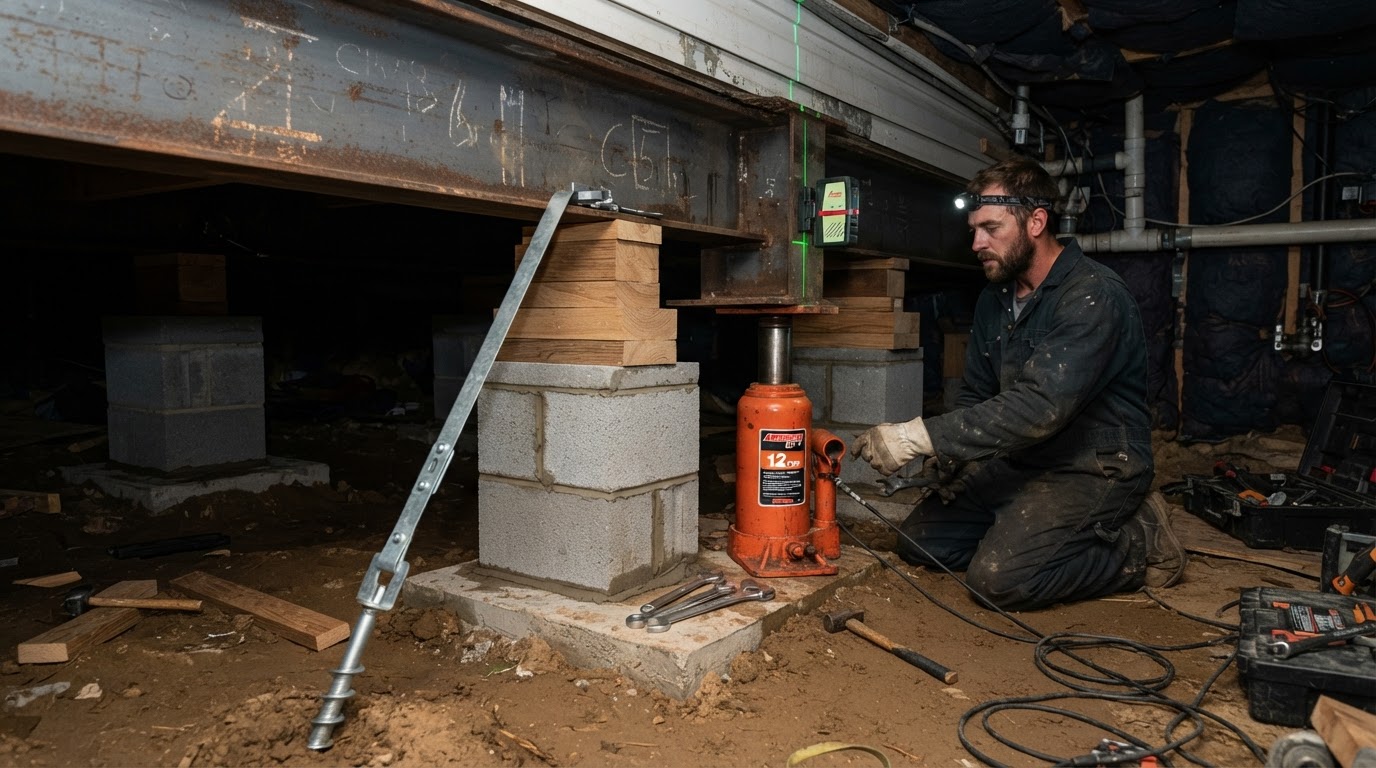
Re-leveling involves systematically elevating settled frame points using heavy hydraulic toe jacks guided by high-precision water levels or optical rotary lasers. Once the chassis rails match original factory tolerances, support piers are rebuilt or re-shimmed with rot-resistant hardwood or steel shim plates to distribute the home's weight evenly across every bearing point. Mobile and manufactured home leveling near Millsboro begins with a crawlspace inspection that maps where the frame has actually moved.
Single-Wide vs. Double-Wide Structural Considerations
Single-wide homes feature two main steel longitudinal rails running front-to-back. Leveling focuses on eliminating crown, sag, or side-to-side twist, and single-wide mobile home leveling is approached as one continuous chassis. Double-wide homes consist of two distinct chassis units pulled together along a central structural seam called the marriage line, and double-wide manufactured home leveling coordinates both sections along that seam. Larger multi-section and triple-wide homes add additional frames and marriage lines that require a broader footprint evaluation. Leveling a double-wide requires precise simultaneous adjustment of both perimeter piers and heavy central marriage-line column piers to eliminate floor gaps and roof seam stress. Homes that were previously level and have since shifted are addressed through mobile home re-leveling.
Common Warning Signs Your Home Is Out of Level
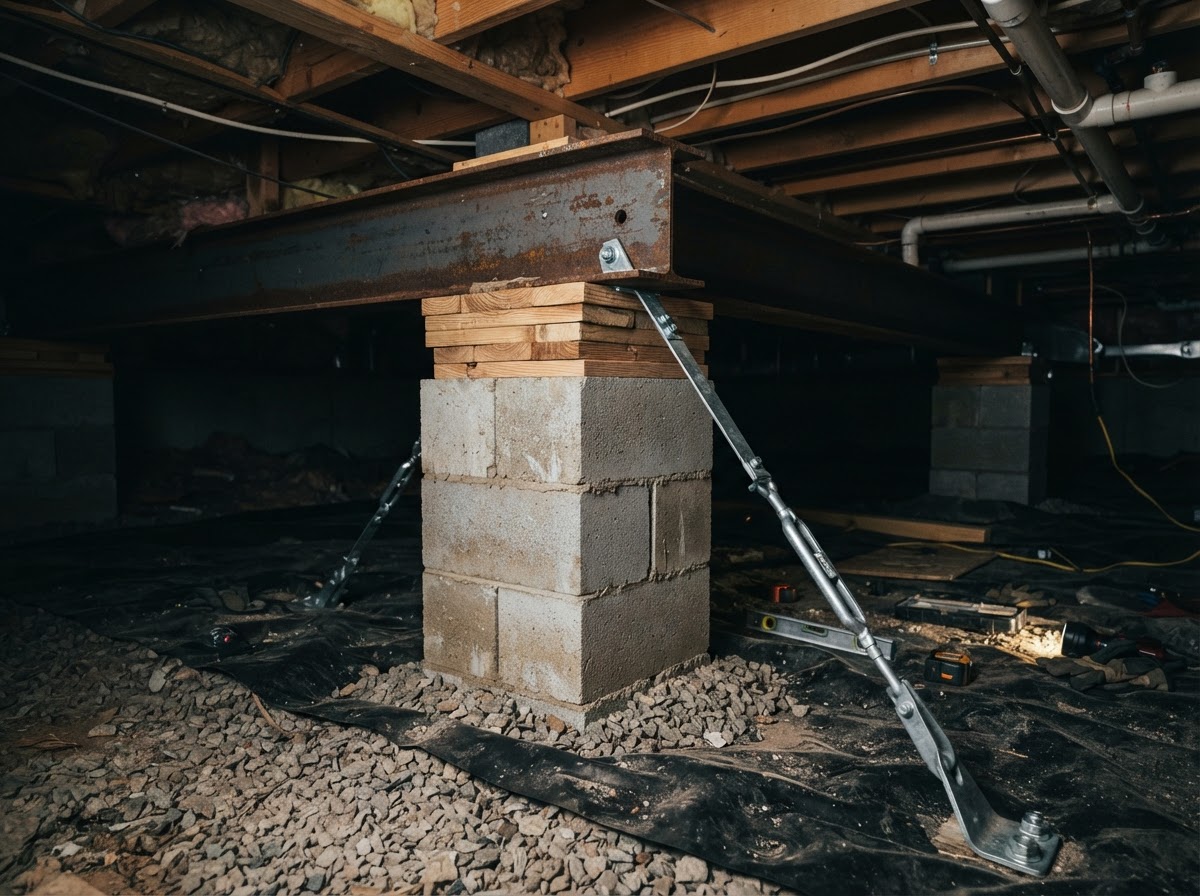
Crawlspace Pier & Shim Mechanics
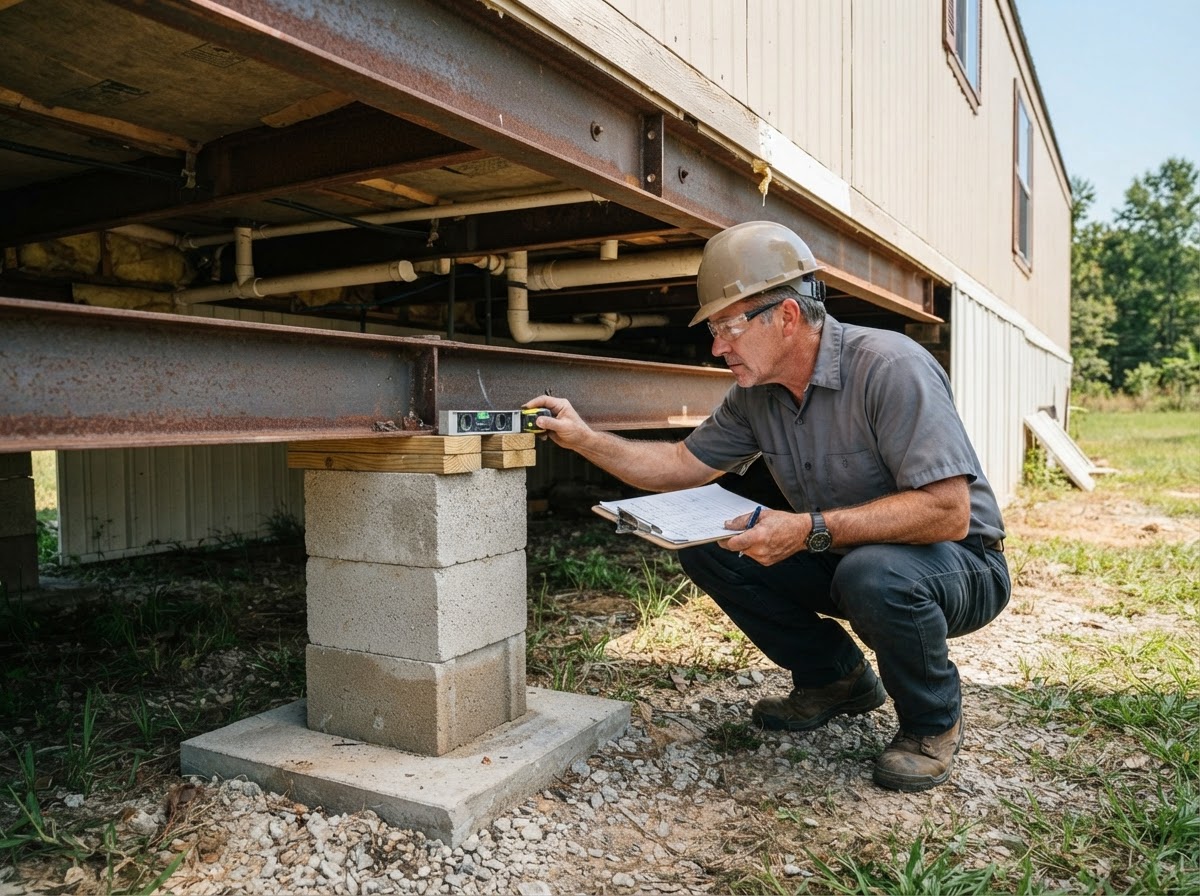
Concrete masonry unit (CMU) piers rest on precast or poured concrete footings. Solid hardwood wedge shims sit directly between the top cap block and the bottom flange of the steel I-beam to lock in final fine-level adjustments.
Why an Initial Crawlspace Inspection Matters
Before lifting a single hydraulic jack, a thorough crawlspace evaluation checks pad stability, soil moisture, chassis frame condition, outrigger clips, and tie-down strap tension. Attempting to level a home over broken concrete pads or leaning piers without structural repairs yields only temporary alignment.
Mobile Home Foundation Repair & Structural Support in Millsboro
Comprehensive repair and stabilization for crawlspace masonry piers, concrete pads, hardwood shims, and main steel chassis components. See the full mobile home foundation repair page for how damaged supports are evaluated and corrected near Millsboro. When a home keeps settling in the same spot, the broader manufactured home foundation stabilization page covers stopping that recurring movement, and the mobile home pier repair page covers individual sinking or leaning piers.
Block Pier Repair & Replacement
Masonry CMU block piers can tilt, spall, crumble, or shift off vertical axis under soil movement or storm surges. We unweight impacted piers, clear degraded blocks, and re-stack heavy-duty concrete masonry units topped with solid cap blocks in full alignment with manufactured home installation standards.
Concrete Footing & Pad Repair
Concrete bearing pads transfer total house load to underlying soil strata. When precast pads crack, fracture, or sink into soft, saturated ground, the pier above fails. We excavate around settled pads, re-compact soil base, and reset or install replacement reinforced concrete footings.
Hardwood Shimming & Reshimming
Soft or rotted pine shims compress over time, creating a gap between the pier cap and steel beam. We replace failing shims with high-density hardwood or engineered polymer shims driven tightly in opposing pairs to restore solid point-load contact across the entire crawlspace foundation grid.
I-Beam & Steel Frame Support
Longitudinal steel I-beams, outriggers, and crossmembers can experience localized deflection or twisting if supports sink unevenly. We install auxiliary steel piers, re-support outrigger arms, and reinforce key weight-bearing frame nodes beneath high-load interior areas.
Reblocking & Setup Correction
Older homes or homes installed over improperly prepared ground often exhibit missing piers, excessive pier spacing, or improper stacking. We add supplemental piers to shorten beam spans and bring the support configuration into full compliance with structural weight guidelines.
Permanent Foundation Considerations
For home buyers or sellers seeking lending qualification or permanent foundation retrofit standards, we evaluate perimeter curtain wall support, central column piers, and ground anchoring systems to address structural deficiencies prior to real estate transactions.
Understanding Key Technical Differences
Re-Leveling
Hydraulically adjusting frame height and shims to bring the chassis back to a flat, horizontal plane.
Pier Correction
Rebuilding, plumbing, or resetting CMU masonry blocks and concrete footings that have tipped or displaced.
Foundation Stabilization
Reinforcing soil bearing areas, adding supplemental piers, and retensioning anchors to prevent future movement.
Mobile Home Anchoring & Tie-Down Services Near Millsboro
Protecting manufactured structures against uplift, sliding, and lateral shear forces in coastal Delaware wind environments.
Coastal Sussex County, Delaware experiences severe seasonal storm events, Atlantic nor'easters, and high-wind gusts. Because manufactured homes rest on pier grids rather than deep continuous poured basements, they rely heavily on specialized ground anchoring and tie-down strap systems to prevent wind uplift, sliding, or rollover.
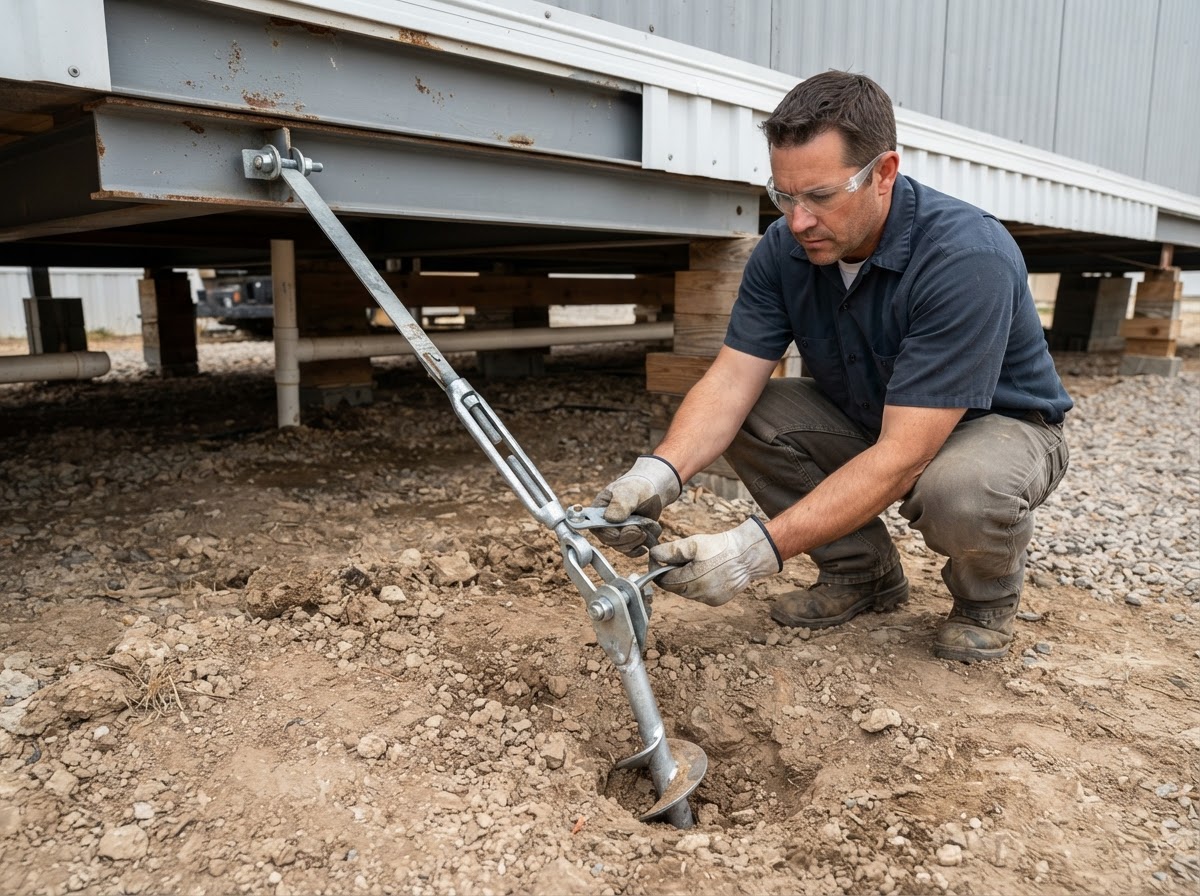
A complete anchoring assembly consists of steel helix earth anchors driven deep into firm soil, heavy-gauge galvanized steel tie-down straps wrapped around the main I-beams or attached to frame brackets, stabilizer plates placed alongside anchor heads, and tensioning split-bolts. Over time, humidity, salt air exposure, and soil dampness cause galvanized straps to rust, slacken, or snap.
Millsboro Mobile Home Leveling inspects, retension, repairs, and replaces ground anchors and tie-down strapping. When inspecting tie-down systems, we check strap gauge, corrosion depth, tension bolt integrity, anchor alignment, and stabilizer plate placement. Loose straps are retensioned to proper torque; rusted or pitted straps are replaced with corrosion-resistant heavy-duty strapping. Learn more about our full mobile home anchoring & tie-down services near Millsboro.
Important Jurisdictional & Installation Note
Applicable manufactured housing installation guidelines, wind resistance requirements, and anchor spacing vary depending on the home’s manufacturing date, HUD wind zone classification, foundation design, and municipal jurisdiction. We perform tie-down repairs and retrofits tailored to property-specific crawlspace conditions and existing frame configurations.
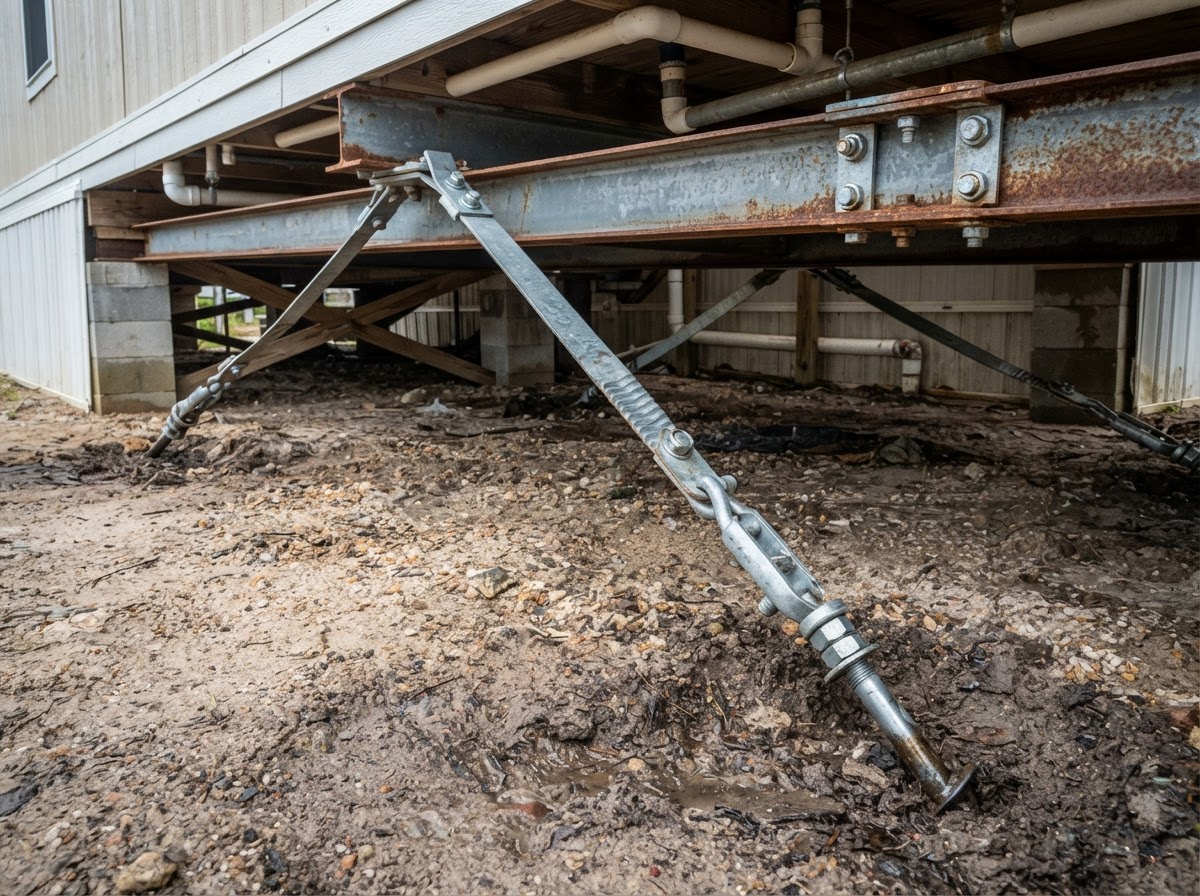
Tie-Down System Components
Diagonal strapping connects steel frame outriggers to ground anchors embedded in firm subsoil strata, locking the home against coastal wind uplift.
Mobile Home Leveling, Foundation, Anchoring & Support Services Near Millsboro
Millsboro Mobile Home Leveling focuses on manufactured and mobile-home structural support systems — leveling and re-leveling, single-wide and double-wide support, pier and block systems, pads and footings, shimming, reblocking, structural stabilization, anchoring, tie-down straps, ground anchors, foundation inspections, and permanent foundation and retrofit considerations. Manufactured homes use support and anchoring systems that differ from many conventional site-built foundations, and the correct service depends on what has actually moved, failed, loosened or deteriorated. The six categories below organize all thirty core services so homeowners can find the right path from a symptom to the appropriate evaluation.
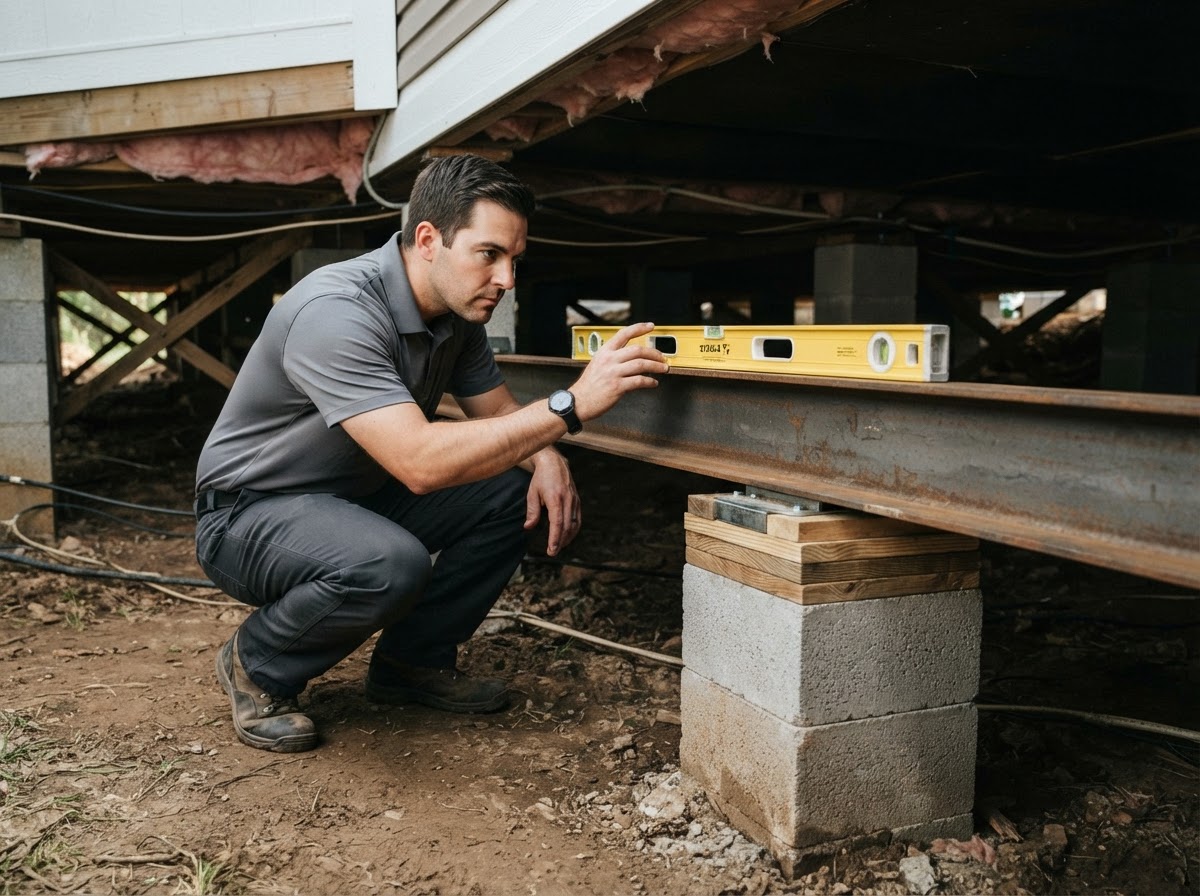
Mobile & Manufactured Home Leveling Near Millsboro
Mobile home leveling corrects the elevation of a manufactured-home frame when part of the structure sits high or low relative to its support system. For single-wide homes the work centers on one continuous steel chassis, while double-wide manufactured home leveling coordinates two sections along the marriage line, and multi-section and triple-wide homes add additional frames and seams that require a broader footprint evaluation.
Homes that were previously level and have since shifted are addressed through mobile home re-leveling, which restores chassis alignment after settlement. The process reads relative elevation along the steel main rails before any support is adjusted, and it distinguishes a true leveling need from a deeper support problem.
Mobile home leveling corrects elevation. If the home became unlevel because a pier, pad, block or other support moved or failed, foundation repair may also be necessary. Recurring loss of level is a signal that the support beneath the frame deserves evaluation rather than repeated adjustment alone — see leveling vs. foundation repair and what causes a mobile home to become unlevel.
Considerations for Millsboro Homeowners
- Correct high and low areas in the structural frame
- Address floor-slope concerns tied to support elevation
- Evaluate single-wide and multi-section support relationships
- Identify whether recurring level problems point to a deeper support issue
- Improve section-to-section alignment where appropriate
Services in This Category
Mobile Home Foundation Repair Near Millsboro
Foundation repair addresses the components that carry the home rather than simply the elevation above them. The load path under a manufactured home runs Frame / I-Beam → Shim → Pier or Block → Pad / Footing → Supporting Surface. Movement lower in that path can cause symptoms higher in the home, so a sloping floor or a sticking door may trace back to a settled pad or a shifted block rather than the frame itself.
Mobile home foundation repair evaluates piers, block supports, pads and footings together to determine whether a single component failed or a broader support system is involved. An isolated pier repair differs from correcting a cracked or settled concrete pad or footing, and both differ from rebuilding block piers that have tilted or deteriorated.
Is foundation repair the same as leveling? No. Leveling corrects elevation, while foundation repair addresses damaged, settled or shifted support components. A home may need one or both depending on the underlying cause — learn more in mobile home foundation types explained.
Considerations for Millsboro Homeowners
- Restore damaged or shifted support components
- Address isolated pier or block problems
- Correct failed or settled bearing components
- Reduce the need for repeated leveling when the actual support is the problem
- Clarify whether repairs involve one component or a broader support system
Services in This Category
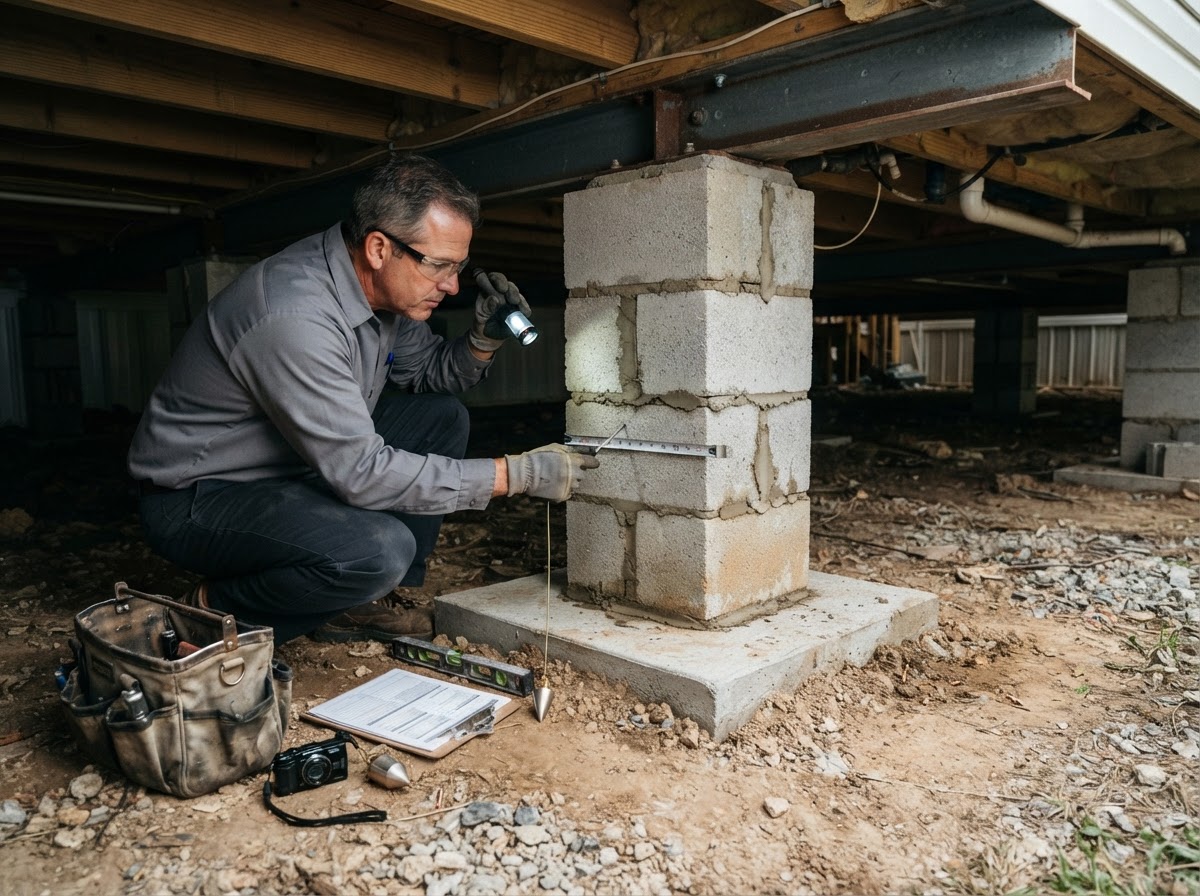
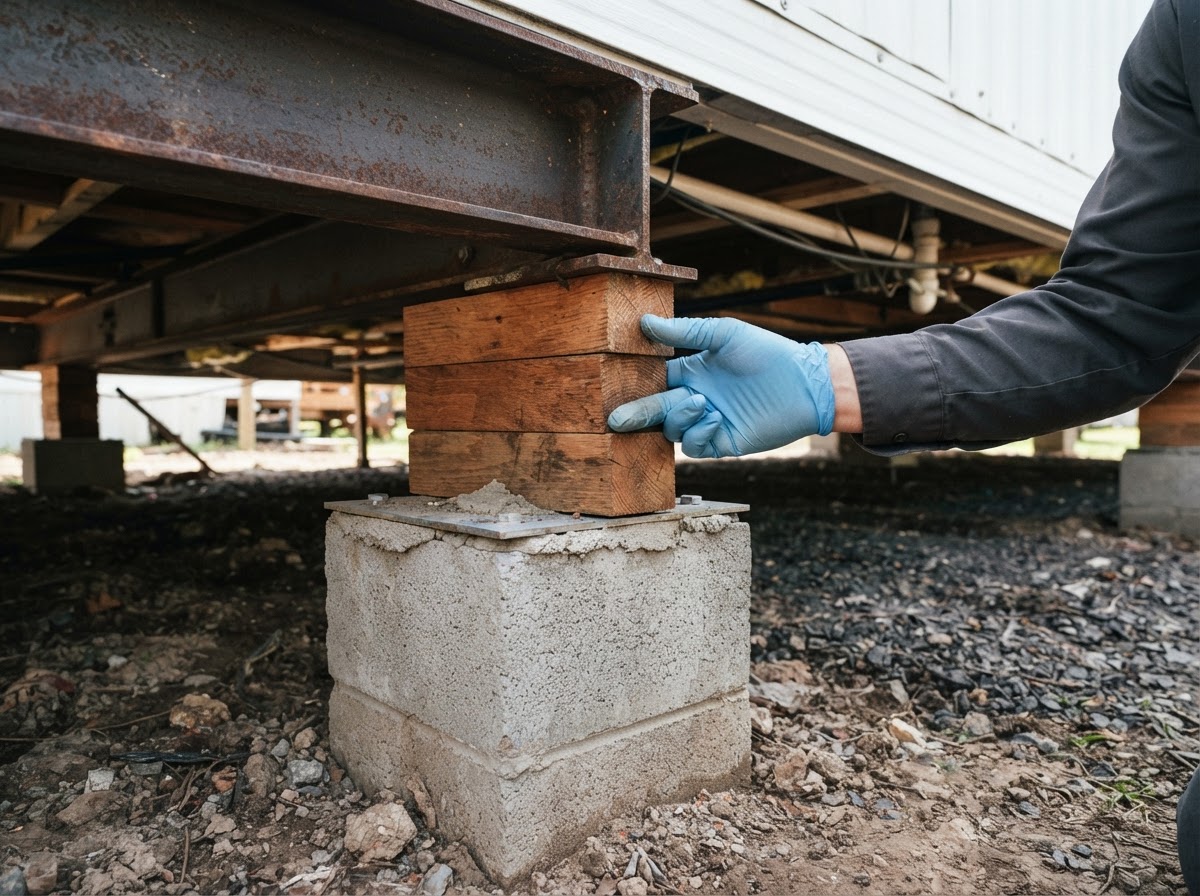
Mobile Home Shimming, Structural Support & Reblocking in Millsboro
Support contact and support layout both affect the manufactured-home frame. Shimming and reshimming restores bearing where a shim has loosened, compressed or fallen out, while broader reblocking and setup correction addresses a pier-and-block arrangement in which multiple supports are shifted, missing or inconsistently placed.
A loose shim may be the visible symptom of movement below the support rather than the original cause. Reading the frame, shims and piers together helps distinguish an isolated support correction from a broader setup problem. When the steel chassis itself has deflected or lost support, I-beam and frame support repair and structural support repair evaluate the load path as a system.
A home that shakes or rocks when walked through can reflect a support contact problem — see mobile home shaking or rocking when walking — and loose or missing shims are read alongside the pier and pad beneath them rather than treated in isolation.
Considerations for Millsboro Homeowners
- Restore appropriate bearing/contact where applicable
- Correct displaced or missing support components
- Evaluate broader support-layout problems
- Address multiple shifted supports through reblocking where appropriate
- Review the relationship between frame, shims and piers
- Distinguish isolated support correction from broader setup problems
Services in This Category
Manufactured Home Foundation Stabilization & Retrofits Near Millsboro
Some homes need more than a one-time level correction. Foundation stabilization addresses recurring or continued movement, while a foundation retrofit coordinates upgrades to older or underperforming support systems — piers, pads, shims and reblocking together — rather than treating one symptom at a time.
Leveling fixes current elevation. Stabilization addresses recurring or continued movement. When a home keeps settling in the same spot, the bearing surface or support layout usually deserves attention. Underpinning and foundation support adds or improves structural support in weak or settled areas, and permanent foundation systems describe long-term support and anchoring configurations designed around the actual home and site.
A permanent or retrofit foundation does not automatically satisfy FHA, VA, lender, engineering or code requirements — those depend on the specific program, jurisdiction and property. Any retrofit is matched to the actual home and site rather than assumed to meet a particular standard.
Considerations for Millsboro Homeowners
- Address recurring foundation movement
- Improve inadequate support where appropriate
- Evaluate broader foundation retrofit needs
- Add or improve structural support in problem areas
- Coordinate foundation-system correction with the actual home/site requirements
Services in This Category
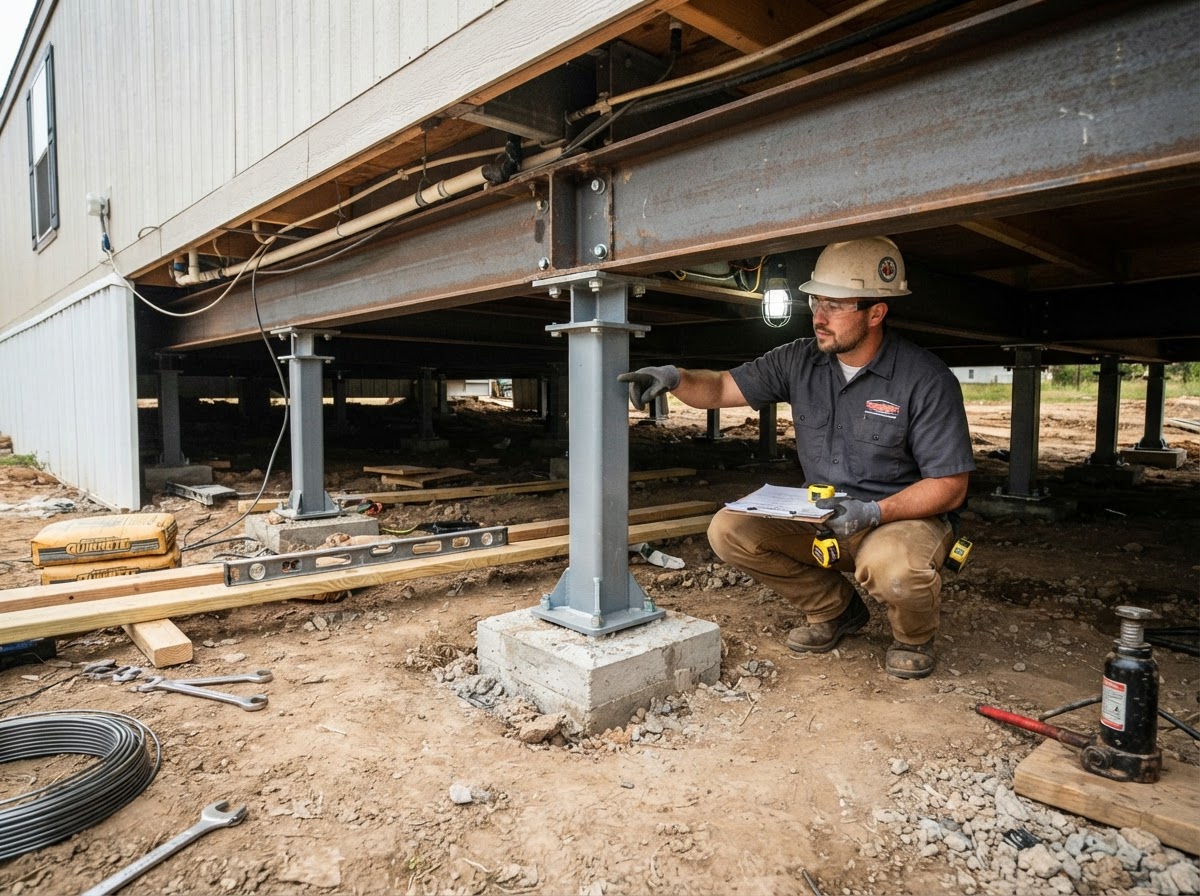
Mobile Home Anchoring & Tie-Down Services Near Millsboro
The manufactured-home anchoring system is separate from the vertical supports that hold the home at elevation. The path runs Frame → Tie / Strap → Ground Anchor, and it is designed to help resist applicable lateral and uplift forces rather than carry the home's weight. Anchoring and tie-down services evaluate that system as a whole.
Are tie-downs part of leveling? No. Tie-downs and ground anchors serve a different structural function from the vertical supports that hold the home at elevation. A mobile home can be level and still have an anchoring problem, and it can have intact tie-downs while its foundation supports are unlevel. Tie-down strap replacement and ground anchor installation and replacement are therefore evaluated independently from leveling work.
Visible corrosion, loose straps, missing anchors and damaged frame connections are read by condition. An anchor and tie-down inspection maps what is present and what is deteriorated, and wind-resistant anchoring upgrades and storm and high-wind tie-down retrofitting improve the completeness of an older or incomplete system. See the coastal Delaware wind and anchoring requirements resource for the regulatory context.
Considerations for Millsboro Homeowners
- Identify missing or deteriorated anchoring components
- Replace damaged straps where appropriate
- Evaluate visible ground-anchor condition
- Correct loose or disconnected components
- Improve the completeness of the manufactured-home anchoring system
- Separate anchoring needs from foundation/leveling needs
Services in This Category
Mobile Home Foundation & Leveling Inspections in Millsboro
An evaluation is often the right first step for homeowners who notice symptoms, are buying a manufactured home, are preparing to sell, have unknown foundation history, or have concerns after heavy weather. A foundation and leveling inspection reads level and elevation alongside the visible support system rather than assuming the cause from a single symptom.
The inspection may consider relative level and elevation, piers, blocks, pads and footings, shims, frame-support relationships, the marriage line, and visible anchoring components where relevant. It helps clarify whether a concern appears related to leveling, foundation repair, anchoring, or a combination — and it creates a clearer path toward the appropriate service.
For buyers, a pre-purchase foundation inspection reads the supports and anchoring system before closing, and the buyer foundation inspection checklist resource explains what to understand ahead of time. A foundation or leveling evaluation is not automatically an engineering certification; projects requiring engineering or other specialty documentation may need the appropriate qualified professional.
Considerations for Millsboro Homeowners
- Identify whether symptoms appear related to leveling or foundation repair
- Evaluate visible support-system condition
- Help buyers understand foundation concerns before purchase
- Identify recurring movement that deserves further correction
- Check preventive-maintenance concerns
- Create a clearer path toward the appropriate service
Services in This Category
Not Sure Which Service Fits Your Home?
A foundation and leveling evaluation reads the supports and anchoring system together so the correct service is identified before any work begins. Call to discuss what you are seeing, or request service and we can follow up using the phone number you provide.
Mobile Home Leveling & Foundation Pricing in Millsboro, DE
How much does mobile home leveling cost in Millsboro and Sussex County, DE? There is no single fixed number — manufactured home foundation pricing varies based on the scope of work, single-wide vs. double-wide configuration, existing pier and pad condition, degree of settlement, accessibility beneath the home, and tie-down strap needs. The planning ranges below reflect typical residential mobile home leveling, reblocking, pier repair, pad replacement, and anchoring service ranges. Final pricing depends on crawlspace inspection, number of support points, and required hardware. These figures are general planning ranges, not guaranteed quotes.
Popular Mobile Home Project Pricing
Quick planning ranges for the most-requested Millsboro manufactured home services. Open the pricing explorer below for the full service inventory.
Single-Wide Leveling
Home length, settlement degree, and pier count set the range.
Double-Wide Leveling
Marriage-line alignment and dual-section support drive scope.
Pier & Block Repair
Resetting leaning blocks or replacing damaged masonry components.
Anchoring & Tie-Downs
Strap retensioning, helix ground augers, and wind upgrades.
Explore Mobile Home Pricing by Project Type
Open a project category to compare typical planning ranges, materials, labor, and site conditions that may affect the final cost.
Single-Wide Mobile Home Leveling
Home length, degree of floor or frame slope, number of piers needing adjustment, shim condition, existing block and pier condition, access beneath the home, and whether foundation repairs are discovered during leveling.
Straightforward single-wide re-leveling generally lands near the lower end; extensive settlement, poor crawlspace access, or damaged support blocks increase overall scope.
Double-Wide Manufactured Home Leveling
Two structural sections, number of support points, amount of settlement, marriage-line relationship, pier and shim condition, accessibility, and whether one or both sections require significant correction.
Double-wide homes feature central marriage-line supports and require balanced elevation adjustments across both halves to avoid structural strain.
Multi-Section & Triple-Wide Home Leveling
Number of manufactured-home sections, total support count, section-to-section alignment, amount of movement, pier condition, shim corrections, access, and whether structural-support repairs are required.
Larger multi-section footprints feature extensive pier layouts and complex alignment tolerances between modules.
Pier & Block Pier Repair or Replacement
Number of affected supports, whether existing concrete blocks can be reset, damaged or leaning piers, cap block integrity, bearing surface condition, and access clearance.
Isolated leaning pier resets require less time than replacing cracked hollow blocks with solid masonry units or cured concrete caps.
Concrete Footing & Foundation Pad Repair
Number of broken, cracked or sinking pads, subgrade soil stability, ABS runner pads vs. poured concrete footers, excavation access, and re-leveling needs.
Cracked pads from subgrade movement allow piers to sink unevenly. Corrective work replaces degraded footings with reinforced composite pads or poured footers.
Shimming & Reshimming Services
Number of loose, split, rotting, or missing wood shims, I-beam bearing contact, cap block condition, hardwood shim replacement, and elevation calibration.
Often performed alongside re-leveling to eliminate floor bounce and close gaps between steel I-beams and masonry piers.
Setup Correction & Complete Reblocking
Total piers re-stacked, spacing correction, double-stacking for heights exceeding 36 inches, frame alignment, and foundation stabilization.
Comprehensive reblocking re-establishes correct pier layout, spacing, and vertical plumbness according to Delaware manufacturer setup standards.
Six Factors That Shape Your Mobile Home Project Cost
Every Sussex County site is distinct. These core variables dictate whether work requires routine shimming or specialized foundation repair.
Single-wide, double-wide and multi-section homes contain different numbers of structural sections and support points.
Minor adjustment and significant settlement are not the same project.
Damaged or moving support components may require repair in addition to leveling.
One isolated support issue generally differs from widespread reblocking or foundation correction.
Skirting, crawl clearance and other physical access conditions can affect labor.
Tie-downs, ground anchors, stabilization, underpinning and specialized support work can change the overall scope.
Request an Accurate Mobile Home Foundation Estimate in Millsboro, DE
Accurate pricing requires information about your specific home and property conditions. Helpful details include single-wide vs. double-wide, approximate age, pier type (concrete block vs. steel stands), symptoms (sticking doors, sloping floors), and whether anchoring inspections are required.
Cost Planning & Estimation Guides
Mobile Home Leveling, Foundation & Anchoring Project Gallery Near Millsboro
The gallery below illustrates the types of manufactured-home support systems and repair conditions Millsboro Mobile Home Leveling is equipped to evaluate and service around Millsboro and surrounding Delaware communities. Each group represents a distinct area of work — mobile home leveling projects in Millsboro, manufactured home foundation repair near Millsboro, double-wide leveling, pier and block repair, pad and footing correction, shimming, reblocking, foundation stabilization, tie-down replacement, ground anchor service, and foundation inspections. The photographs are organized so homeowners can connect a visible support or anchoring condition with the relevant service and learn where to read more about it.
Gallery images are representative service examples intended to illustrate common manufactured-home leveling, foundation-support, pier, pad, shimming, reblocking, anchoring and inspection projects. Actual project appearance varies by home, foundation system, materials, access and site conditions.
Ten Service Areas Covered in the Gallery
Each gallery group connects a visible support or anchoring condition with the relevant Millsboro service. Open any group to read more about the work involved.
Mobile Home Leveling & Re-Leveling Projects in Millsboro
Manufactured-home leveling corrects structural elevation when part of the frame sits high or low relative to the supporting pier and block system. If the home became unlevel because a pier, pad, block or other support moved or failed, foundation repair may also be necessary in addition to level correction.
Double-Wide Leveling & Marriage-Line Alignment Near Millsboro
Double-wide work considers the elevation of both structural sections and their relationship at the marriage line. Correcting one section without evaluating the section-to-section relationship can leave a center-line elevation difference in place even after individual supports are adjusted.
Mobile Home Pier & Block Pier Repair in Millsboro
Individual piers or block supports can shift, settle, lean or deteriorate independently of other support points. An isolated pier correction is a different scope from a project involving several damaged or shifted supports, so the affected locations are evaluated individually before the support path is corrected.
Mobile Home Concrete Pad & Footing Repair Near Millsboro
The bearing area beneath a pier or block support can affect the support above it. Settled, cracked or damaged pads may require correction in addition to leveling, because a pier can only perform properly when the bearing surface beneath it remains suitable.
Mobile Home Shimming & Reshimming in Millsboro
Shims help maintain appropriate bearing and contact between the manufactured-home frame and the supporting pier system. A loose shim may be a symptom of movement below it rather than the original cause, so the support beneath the shim is evaluated before reshimming alone is treated as the fix.
Mobile Home Reblocking & Support System Correction Near Millsboro
Reblocking addresses broader support-layout problems involving multiple piers or block supports rather than one isolated adjustment. When several supports have shifted or the setup has become inconsistent, reblocking corrects the support layout as a system instead of adjusting a single point.
Manufactured Home Foundation Stabilization & Underpinning in Millsboro
Stabilization addresses recurring or continued movement when ordinary level correction alone does not resolve the foundation condition. Underpinning or support improvements may be appropriate depending on the home and the existing support configuration, and the scope is matched to the actual support condition rather than applied to every home.
Mobile Home Tie-Down & Anchoring Services Near Millsboro
The anchoring system is separate from the vertical pier and pad support system. It may involve tie-down straps, frame connections and ground anchors, and components can corrode, loosen or become damaged over time. Replacement or correction of the anchoring system is evaluated independently from the home's leveling condition.
Mobile Home Ground Anchor Repair & Replacement in Millsboro
Missing, damaged or deteriorated ground-anchor components may need correction independently from whether the home itself is currently level. The accessible anchor hardware and tie connections are evaluated to determine whether a single component or a broader anchoring correction is appropriate.
Mobile Home Foundation & Leveling Inspections Near Millsboro
Inspection and preventive service may evaluate relative frame elevation, piers, blocks, pads, shims, marriage-line relationships, visible frame support and anchoring components where relevant. A foundation or leveling evaluation is a support-condition assessment, not an engineering certification unless separately verified.
Discuss Your Mobile Home Leveling or Foundation Project in Millsboro
Contact Millsboro Mobile Home Leveling to discuss the home, symptoms and type of foundation or anchoring service you may need. Basic information about the home and the visible problem can help clarify which service is most relevant. Please do not crawl under an unsafe or unstable home to take photographs — a description of the symptoms you are seeing is enough to start the conversation.
Signs Your Mobile Home May Be Out of Level
Identify common interior and crawlspace symptoms before minor settlement causes cosmetic or structural damage.
Sinking on One Side
When one side of a manufactured home sits noticeably lower than the other, the cause often involves pier settlement, pad movement, washout, or another foundation condition beneath that side of the home.
Uneven or Sloping Floors
Floors that feel different from room to room can come from the support system or the floor system itself. A dedicated floor sloping or dipping evaluation helps tell the two apart.
Sticking Doors & Windows
When the chassis frame shifts out of alignment, door and window openings can twist out of square, causing doors to rub or refuse to latch. Several openings sticking together is a stronger sign of settlement than one.
Shaking or Rocking When Walking
Movement felt while walking through a manufactured home can come from the support system beneath it — loose shims, pier movement, or a leveling change — or from a localized floor-system condition. An evaluation reads the supports before assuming the cause.
Pier Sinking & Settlement
A pier that drops downward usually points to a bearing problem beneath it — a settled pad, lost bearing material, or washout. Adding shims alone rarely stops the drop.
Leaning or Shifted Pier
A pier that leans, shifts sideways, or moves off-center is a lateral movement problem — different from a sinking pier that drops straight down. The repair is matched to the actual movement.
Cracked Foundation Pad
A cracked or broken concrete pad beneath a pier is a bearing-surface problem — different from a damaged pier above it. Hairline cracks without movement may be cosmetic; a broken or settled pad can let the pier above it drop.
Loose or Missing Shims
A shim that has loosened, compressed, or fallen out is a lost bearing-contact point — often a symptom of pier or pad settlement beneath it rather than the shim alone.
Rusted Tie-Down Straps
Surface rust alone is not automatic failure, but heavy flaking, pitting, or connection-point corrosion on a tie-down strap is read by severity and evaluated with the anchor it connects to.
Loose Tie-Downs
A slack or disconnected tie-down strap is a symptom — the cause is identified before any tightening, since a shifted anchor or loosened frame connection can be the real problem.
Missing or Damaged Anchors
A missing, bent, shifted, or heavily corroded ground anchor leaves the strap above it with nothing reliable to hold against — a bearing problem at the bottom of the connection path.
Marriage Line Separation
When the two sections of a double-wide no longer meet evenly, the cause can be differential settlement beneath one half — though some seam separation is cosmetic and not foundation-related. Both sections are read together.
Movement After Heavy Rain
New floor slope, a shifted pier, or a shim gap appearing after heavy rain can mean water eroded bearing material — or that rain revealed a pre-existing weakness. The cause is evaluated at the affected support.
Re-Leveling After a Storm
Not every storm requires re-leveling, but new level or support symptoms after a storm warrant an inspection — leveling over a shifted pier or eroded pad can move the symptom without correcting the cause.
Flood & Washout Repair
Visible washout — eroded bearing, an exposed pad, or an undermined pier — is a foundation support problem, not just a leveling symptom. Leveling alone does not restore eroded bearing beneath a support.
Soft Soil Settlement
When the supporting material beneath a pad compresses or settles, the pier above drops with it. A floor slope alone does not diagnose soft soil — the pad, pier, and bearing are read together at the affected support.
Crawlspace Erosion & Washout
Channels, exposed pad edges, or voids beneath the home show that bearing material has moved. Erosion deserves attention even before the home is obviously out of level, because bearing loss can be developing at a support.
Failed Inspection Corrections
When a buyer, lender, or inspector has cited foundation or anchoring deficiencies, the corrections follow the specific findings — with no guarantee that any repair will automatically pass a future inspection.
Foundation Problems Before Selling
Level, support, and anchoring issues often surface during a buyer inspection. A pre-sale evaluation reads the supports and anchoring system before a buyer does — without real-estate guarantees or legal advice.
From Site Inspection to Finished Alignment
A clear, non-destructive 6-step diagnostic and corrective workflow tailored to manufactured housing substructures.
Initial Property Symptom Consultation
We review visible interior symptoms, including sticking doors, sloping floors, drywall crack locations, and home age/type with the homeowner.
Precision Level Diagnostic Measurement
Using high-accuracy water levels or electronic rotary lasers, we record elevation points along the steel longitudinal I-beams to map frame deflection.
Crawlspace Structural & Anchor Check
We physically inspect accessible concrete pads, CMU piers, shims, frame crossmembers, outriggers, tie-down straps, and ground anchors for degradation.
Corrective Action Plan Determination
We outline whether the home requires simple re-shimming, hydraulic frame jacking, pier rebuilding, pad excavation/resets, or tie-down strap replacement.
Hydraulic Jacking & Pier Stabilization
Heavy hydraulic toe jacks unweight settled points along the chassis; piers are plumbed, solid hardwood shims are driven home, and straps are retensioned.
Final Level Verification & Maintenance Guidance
We re-verify level readings along all rails, test interior door clearances, and explain crawlspace moisture and soil maintenance recommendations.
Manufactured Home Foundation Services Near Millsboro & Across Sussex County
Serving mobile home communities, private acreage installations, and coastal manufactured home parks throughout Sussex County, DE.
Our primary operating base is centered in Millsboro, DE, positioned at the heart of Sussex County's manufactured housing concentration. Due to coastal geography, tidal river proximity, and varied soil compositions ranging from sandy loams to inland clay strata, crawlspace foundation behavior varies significantly across neighboring towns.
In addition to Millsboro, we regularly evaluate and service manufactured homes in nearby communities such as Long Neck, Dagsboro, Georgetown, Frankford, Harbeson, Selbyville, Millville, Ocean View, Bethany Beach, Lewes, and Rehoboth Beach.
Actual foundation recommendations, pier spacing requirements, and anchoring scope depend on property-specific variables including home age, single-wide or multi-chassis design, existing pad support type, perimeter drainage, and underlying soil stability.
Surrounding Sussex County Service Hubs
Millsboro, DE Service Area
Fast response times for mobile home leveling inspections throughout Millsboro zip codes and surrounding rural/coastal routes in Sussex County.
Educational Guides for Delaware Homeowners
Plain-language resources on leveling frequency, warning signs, and cost factors — written to help you understand the support system beneath your manufactured home before deciding on a repair.
Signs Your Home Is Out of Level
A practical symptom checklist — uneven floors, sticking doors, shim gaps, pier movement, marriage-line changes.
Leveling vs. Foundation Repair
The difference between elevation correction and component repair — when each is needed and when both apply.
Buyer Foundation Inspection Checklist
What to understand about level, piers, pads, shims, anchoring, and marriage-line condition before buying a manufactured home.
Foundation & Anchoring Maintenance Guide
How to monitor piers, pads, shims, tie-downs, and ground anchors in coastal Delaware — condition-based, not calendar-based.
Wind & Anchoring Requirements in Coastal Delaware
HUD wind zones, tie-downs, ground anchors, and the foundation-vs-anchoring distinction for coastal Sussex County homes.
Single-Wide vs. Double-Wide Leveling
How two structural sections and the marriage line change a double-wide leveling job — without a fixed price multiplier.
Frequently Asked Questions
Direct answers to common questions regarding mobile home re-leveling, pier stability, and tie-down maintenance in coastal Delaware.
Schedule Mobile Home Leveling or Foundation Service Near Millsboro
Connect directly with Millsboro Mobile Home Leveling to discuss your home's foundation symptoms, pier stability, or tie-down requirements.
Direct Phone Contact
Prefer to speak over the phone? Call our local phone number directly for prompt assistance regarding mobile home leveling in Sussex County.
Call 302-449-7221Serving Millsboro & All Sussex County Communities
Single-Wide, Double-Wide & Multi-Section Homes
Specialized Manufactured Home Crawlspace Focus
Request Mobile Home Foundation Service
Serving Millsboro and all surrounding Sussex County communities.